Asia Pacific Thermoplastic Elastomer Production and Volume Outlook
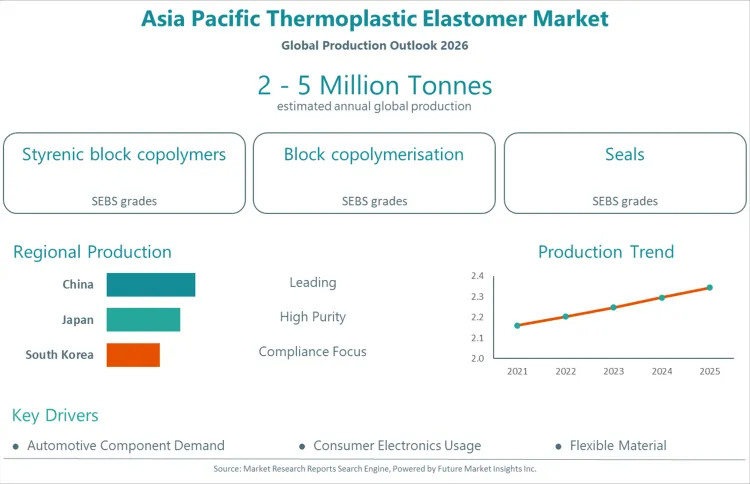
Thermoplastic elastomer production in Asia Pacific in 2026 is estimated at approximately 2 to 3 million tonnes, reflecting the region’s central role in global flexible polymer manufacturing. Output growth is supported by sustained automotive production, consumer electronics assembly, appliance manufacturing and expanding medical device fabrication.
Production capability remains concentrated in China, Japan, South Korea and Southeast Asia, supported by integrated petrochemical feedstocks, advanced compounding infrastructure and proximity to downstream processors. Buyers prioritise formulation consistency, processing reliability and continuity of regional supply.
Key Questions Answered
- How large is thermoplastic elastomer production capacity across Asia Pacific in 2026?
- Where is thermoplastic elastomer production geographically concentrated within the region?
- What manufacturing trends are supporting production volume expansion?
- How stable is regional supply under feedstock and logistics variability?
Thermoplastic Elastomer Families That Define How Buyers Use the Material
Product Classification
- Styrenic block copolymers
- SEBS grades
- SBS grades
- Thermoplastic polyurethanes
- Flexible grades
- Abrasion resistant
- Thermoplastic polyolefins
- Automotive blends
- Softtouch compounds
- Copolyester elastomers
- High temperature
- Chemical resistant
Styrenic and polyolefin-based elastomers account for the largest volumes due to cost efficiency and processing flexibility, while polyurethanes and copolyesters serve performance-driven applications.
Key Questions Answered
- How do thermoplastic elastomer families differ in structure and performance characteristics?
- Why do styrenic and polyolefin elastomers dominate regional production volumes?
- Where are polyurethanes and copolyesters most commonly specified by buyers?
- How do formulation choices influence processing and enduse suitability?
Thermoplastic Elastomer Process Routes That Shape Cost and Performance
Process Classification
- Polymer synthesis
- Block copolymerisation
- Polyaddition reactions
- Compounding operations
- Filler blending
- Additive incorporation
- Property modification
- Hardness adjustment
- Performance optimisation
Production economics are influenced by feedstock pricing, formulation complexity and scale efficiency. Compounding flexibility enables tailored properties for diverse downstream requirements.
Key Questions Answered
- How do upstream polymer feedstocks influence thermoplastic elastomer production costs?
- How does compounding complexity affect operational efficiency and output consistency?
- How are mechanical and thermal properties adjusted during modification stages?
- How does production scale improve cost control across regional facilities?
Thermoplastic Elastomer End Use Distribution Across Key Sectors
End Use Segmentation
- Automotive components
- Seals
- Interior parts
- Consumer products
- Handles
- Grips
- Medical devices
- Tubing
- Closures
- Industrial products
- Gaskets
- Hoses
Automotive and consumer goods applications dominate volume consumption, while medical uses require higher regulatory compliance and formulation precision.
Key Questions Answered
- Why do automotive applications account for the largest share of elastomer usage?
- How do medical device requirements influence material selection and formulation control?
- How are consumer product trends shaping elastomer grade demand?
- How do industrial applications balance durability and processing efficiency?
Thermoplastic Elastomer Regional Production Assessment
China
China leads regional capacity with large-scale compounding facilities and extensive downstream manufacturing integration.
Japan
Japan focuses on high-performance and specialty thermoplastic elastomer formulations.
South Korea
South Korea supplies elastomers aligned with automotive and electronics manufacturing.
Southeast Asia
Southeast Asia expands capacity alongside regional manufacturing relocation.
India
India shows rising demand supported by automotive and appliance growth.
Key Questions Answered
- Which countries account for the majority of regional production capacity?
- How do national manufacturing strengths influence elastomer specialisation?
- Where is new capacity development most likely to occur?
- How integrated are production and downstream processing operations?
Thermoplastic Elastomer Supply Chain and Cost Structure
The supply chain links petrochemical feedstocks, polymer producers, compounders and downstream moulders. Key cost drivers include styrenics and polyolefin pricing, energy consumption and logistics efficiency. Intra-regional trade supports balanced supply across manufacturing hubs.
Key Questions Answered
- Which raw materials have the greatest influence on elastomer production costs?
- How does compounding location affect supply reliability and lead times?
- How do regional logistics networks support crossborder material flows?
- How sensitive is delivered cost to energy and transportation conditions?
Thermoplastic Elastomer Ecosystem and Strategic Considerations
The ecosystem includes resin producers, compounders, moulders, OEMs and regulators. Strategic themes include material substitution from thermoset rubbers, recyclability improvements and compliance with medical and food-contact standards.
Deeper Questions Decision Makers Should Ask
- How secure is longterm access to polymer feedstocks used in elastomer production?
- How diversified are supplier bases across Asia Pacific manufacturing countries?
- How exposed is regional production to regulatory or environmental policy changes?
- How scalable is existing capacity to support future downstream growth?
Bibliography
- Wang, Y., Liu, Z., & Chen, H. (2024). Processing, performance, and recyclability of thermoplastic polyolefin elastomers in automotive applications. Polymer Engineering & Science, 64(9), 2143-2156.
- Ramesh, P., & Kulkarni, S. (2025). Thermoplastic polyurethane elastomers for medical and industrial applications: Material trends and regulatory considerations. Journal of Applied Polymer Science, 142(6), 55102.
- Asian Chemical Industry Association. (2024). Polymer production trends. ACIA Reports.
- International Rubber Study Group. (2024). Elastomer substitution analysis. IRSG Publications.
Frequently Asked Questions
What is the estimated thermoplastic elastomer production volume in Asia Pacific in 2026?
Thermoplastic elastomer production in Asia Pacific in 2026 is estimated at approximately 2 to 3 million tonnes, supported by automotive, consumer goods and medical manufacturing activity.
Why does Asia Pacific account for the largest share of global thermoplastic elastomer output?
Asia Pacific leads production due to integrated petrochemical feedstocks, large-scale compounding capacity and close alignment with downstream manufacturing hubs.
How do thermoplastic elastomers compare with traditional rubber materials in processing?
Thermoplastic elastomers provide rubber-like flexibility while enabling easier processing, recyclability and shorter production cycles.
Which sectors drive the highest thermoplastic elastomer consumption in the region?
Automotive components and consumer goods account for the highest consumption, followed by medical and industrial applications.