On this page
Asia Pacific sodium sulphate production in 2026 is estimated at approximately 10 to 11 million tonnes, making the region the largest global supply base. Output is split between natural sodium sulphate derived from mineral deposits and synthetic sodium sulphate produced as a by product from chemical processes such as hydrochloric acid, rayon and chromate manufacturing.
Production growth is driven primarily by population linked detergent consumption, steady glass manufacturing and textile processing activity rather than rapid industrial expansion. Pricing reflects a low value, high volume profile and is influenced by energy costs, transport distance and local supply density more than feedstock volatility. In many countries, sodium sulphate remains a locally consumed material due to high freight sensitivity.
China dominates regional production through both natural deposits and synthetic capacity. India follows with growing synthetic output tied to detergents and chemicals. Southeast Asia relies more heavily on imports or captive supply linked to specific industries. Northeast Asia maintains stable production aligned with detergents and specialty glass.
Buyers prioritise consistent bulk supply, predictable delivery and stable quality rather than innovation or specification complexity.
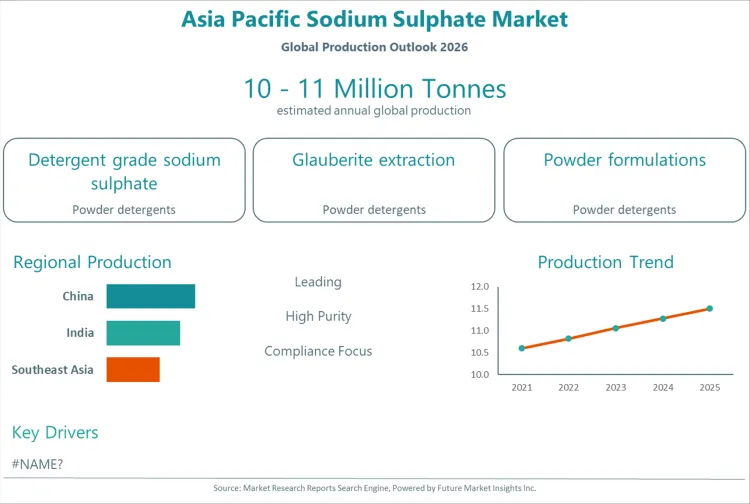
Detergent grade accounts for the largest share of regional volume due to widespread use as a filler and processing aid. Glass and textile grades require tighter control of impurities but remain cost focused. Industrial grades represent smaller but stable demand linked to specific manufacturing chains.
Natural production offers lower operating cost but depends on geology and climate. Synthetic production provides stable output tied to upstream chemical operations. Most Asia Pacific supply is consumed domestically due to low value density.
Detergents dominate regional demand due to population growth and urbanisation. Glass and textile uses provide steady industrial consumption linked to construction and apparel manufacturing cycles.
China leads regional production supported by large natural reserves, synthetic by product output and strong domestic demand.
India shows growing synthetic capacity aligned with detergents, textiles and chemical manufacturing.
Southeast Asia relies on limited domestic production and imports tied to detergent and textile clusters.
Japan and South Korea maintain stable output focused on detergents and specialty glass.
Sodium sulphate supply chains are short and regionally focused. Material flows from mines or chemical plants to detergent, glass and textile facilities, primarily by road or rail. Export volumes remain limited due to low value density.
Energy use, drying efficiency, labour costs and transport distance dominate cost structure. Trade occurs mainly where natural resources are concentrated and domestic demand is insufficient.
The ecosystem includes mining operators, chemical producers, detergent manufacturers, glass producers, textile processors, logistics providers and regulators. Demand is stable and volume driven, with limited technological disruption.
Strategic focus remains on cost control, environmental compliance and maintaining supply reliability close to demand centres.
Asia Pacific production in 2025 is estimated at approximately 10 to 11 million tonnes, with China accounting for the majority.
Energy for drying, labour, transport distance and utilisation rates dominate cost structure.
Low value density makes long haul transport uneconomic except from large natural deposits.
Detergents represent the largest volume consuming sector.
Buyers rely on multiple local suppliers and inventory buffers.
Explore Inorganic Chemicals Insights
View Reports
Asia Pacific Sodium Sulphate Production Capacity and Growth Outlook

Thank you!
You will receive an email from our Business Development Manager. Please be sure to check your SPAM/JUNK folder too.
