On this page
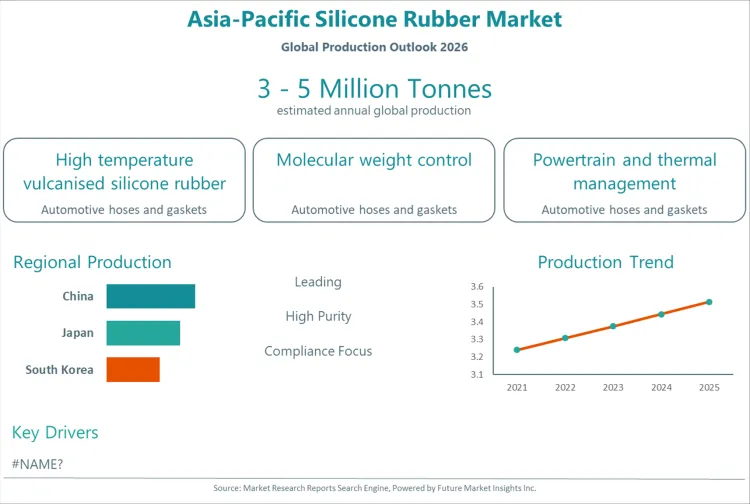
Asia-Pacific silicone rubber production capacity in 2026 is estimated at approximately 3 to 5 million tonnes, reflecting sustained expansion alongside increasing internal consumption. China leads regional output through integrated silicone value chains that span silicon metal, chlorosilanes, polymers, and finished elastomers. Other regional producers focus on specialty grades, formulation depth, and application specific performance rather than volume driven expansion.
Pricing conditions are influenced by silicon metal costs, methyl chloride availability, energy input prices, and operating rates across integrated complexes. Periods of silicon metal tightness or energy disruption can transmit rapidly through the value chain, affecting elastomer pricing and availability. Specialty grades maintain greater pricing stability due to qualification requirements and technical complexity.
Production concentration remains highest in China, followed by Japan and South Korea. Southeast Asia and India rely more heavily on imports despite rising consumption across construction, electronics, and consumer products.
HTV silicone rubber represents the largest volume share due to broad industrial use. LSR and specialty grades grow more rapidly due to demand from medical, electronics, and high precision manufacturing. Buyers prioritise consistency, formulation support, and long term supply reliability.
Integrated producers benefit from tighter control over cost and supply. Non integrated compounders rely on merchant polymers and face greater exposure to upstream price volatility. Buyers value suppliers with strong formulation capability and responsive technical support.
Automotive and electronics applications anchor baseline consumption due to scale and continuity. Construction demand varies by country and investment cycles. Healthcare uses require high purity, traceability, and regulatory compliance, supporting durable supplier relationships.
China dominates regional silicone rubber capacity through vertically integrated production and strong domestic consumption across automotive, electronics, and construction.
Japan focuses on high performance and specialty silicone rubbers supported by advanced formulation and long standing OEM relationships.
South Korea supplies electronics and automotive chains with high consistency materials and export oriented production.
Southeast Asia relies on imports while showing steady growth in construction, electronics assembly, and consumer goods.
India exhibits rising demand with limited domestic silicone rubber production, increasing dependence on imported material.
The silicone rubber supply chain begins with silicon metal production followed by chlorosilane synthesis, polymerisation, compounding, and distribution to converters and OEMs. Energy intensity and capital requirements make upstream stages critical cost drivers.
Primary cost drivers include silicon metal pricing, energy consumption, operating rates, and additive costs. Trade flows within Asia-Pacific are active, with China acting as a major exporter during periods of high operating rates. Specialty grades are less trade intensive due to qualification and proximity requirements.
The Asia-Pacific silicone rubber ecosystem includes silicon metal producers, silicone monomer manufacturers, polymer producers, compounders, converters, and OEMs. Integration across upstream and downstream assets supports scale efficiency, while specialty producers compete through formulation expertise and application development.
Strategic considerations include securing silicon metal supply, managing energy exposure, expanding specialty grade portfolios, and aligning capacity utilisation with automotive, electronics, and healthcare growth trends.
Asia-Pacific silicone rubber production capacity in 2026 is estimated at approximately 3 to 5 million tonnes.
Key influences include silicon metal availability, energy costs, operating rates, and the share of specialty grades.
China benefits from access to silicon metal, large scale integration, and proximity to major downstream manufacturing sectors.
Buyers evaluate thermal performance, durability, regulatory compliance, processing behaviour, and long term supply reliability.
Explore Polymers & Plastics Insights
View Reports
Asia-Pacific Silicone Rubber Production Capacity and Growth Outlook

Thank you!
You will receive an email from our Business Development Manager. Please be sure to check your SPAM/JUNK folder too.
