On this page
Asia-Pacific polyolefin elastomer production capacity in 2026 is estimated at approximately 3 to 4 million tonnes, reflecting rapid capacity build out over the past decade alongside continued reliance on imports for certain grades. China leads recent additions through investments in metallocene based polymerisation, while established producers in South Korea and Japan prioritise consistency, grade breadth, and downstream integration.
Pricing conditions are influenced by ethylene costs, comonomer selection such as octene or butene, catalyst licensing arrangements, and operating rates. Periods of capacity ramp up place pressure on standard grades, while automotive, photovoltaic encapsulant, and specialty packaging grades retain stronger value stability due to qualification requirements and performance differentiation.
Production concentration is highest in China, followed by South Korea and Japan. Southeast Asia remains largely import dependent due to limited metallocene polymer capacity, while India shows rising consumption with minimal domestic production.
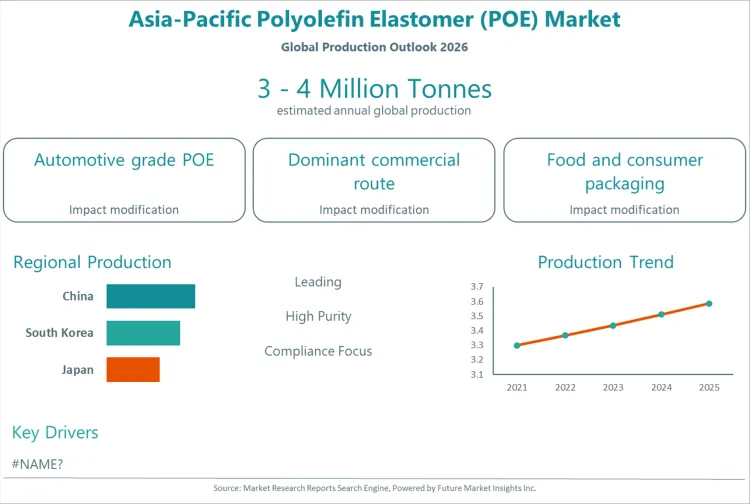
Packaging and film grades represent the largest volume share due to broad use in multilayer structures. Automotive and photovoltaic grades require tighter molecular control and longer qualification cycles, supporting more durable supply relationships.
Integrated producers benefit from tighter control over feedstock and catalyst supply. Non integrated producers face greater exposure to ethylene pricing volatility and licensing constraints. Buyers value suppliers with robust process control and responsive grade development.
Packaging applications anchor baseline consumption due to scale and continuity. Automotive and photovoltaic uses grow steadily with electrification and renewable energy deployment, while consumer applications support volume stability.
China leads regional POE capacity expansion through aggressive investment in metallocene technology aligned with domestic packaging, automotive, and photovoltaic demand.
South Korea focuses on high performance and specialty POE grades supported by strong polymer science capabilities and export oriented production.
Japan maintains selective capacity with emphasis on consistency, reliability, and long standing OEM relationships.
Southeast Asia remains dependent on imports despite rising consumption in packaging and wire and cable applications.
India shows rapid demand growth with limited domestic production, increasing reliance on imported material.
The POE supply chain begins with ethylene sourcing followed by metallocene polymerisation, pelletisation, compounding, and distribution to converters and OEMs. Catalyst licensing and technical support form a critical layer of the value chain.
Primary cost drivers include ethylene pricing, catalyst costs, energy consumption, and plant utilisation. Trade flows within Asia-Pacific remain active due to uneven geographic distribution of production and consumption. Specialty grades are less trade intensive due to qualification requirements and closer customer proximity.
The Asia-Pacific POE ecosystem includes ethylene producers, catalyst licensors, polymer manufacturers, compounders, converters, OEMs, and logistics providers. Integration across feedstocks, polymerisation, and application development supports competitive positioning.
Strategic considerations include securing catalyst access, managing capacity ramp up risk, expanding specialty grade portfolios, and aligning production with long term packaging, automotive, and renewable energy trends.
Asia-Pacific polyolefin elastomer production capacity in 2026 is estimated at approximately 3 to 4 million tonnes.
Key influences include ethylene availability, comonomer selection, catalyst costs, operating rates, and the share of specialty grades.
China benefits from strong downstream demand, government support for advanced materials, and increasing access to metallocene technology.
Buyers evaluate mechanical performance, processing behaviour, qualification history, supply reliability, and long term technical support.
Explore Polymers & Plastics Insights
View Reports
Asia-Pacific Polyolefin Elastomer (POE) Production Capacity and Growth Outlook

Thank you!
You will receive an email from our Business Development Manager. Please be sure to check your SPAM/JUNK folder too.
