On this page
Asia-Pacific polycarbonate production capacity in 2026 is estimated at approximately 7.5 to 8.8 million tonnes, representing the largest regional concentration globally. Capacity growth over recent years has been driven primarily by China through large scale integrated investments aligned with domestic electronics, construction, and automotive consumption. Other regional producers focus on specialty grades and application specific performance rather than volume expansion.
Pricing conditions are influenced by bisphenol A availability, energy costs, operating rates, and grade mix. Periods of capacity additions have created pricing pressure for standard grades, while optical, medical, and high heat resistant grades maintain more stable value levels. Producers face margin sensitivity tied to upstream phenol and acetone economics and energy pricing volatility.
Production concentration is highest in China, followed by South Korea, Japan, and Taiwan. China anchors volume output through backward integration and scale efficiency. Japan and South Korea emphasise high specification materials for electronics and automotive uses. Southeast Asia remains largely import dependent with limited domestic polymerisation assets.
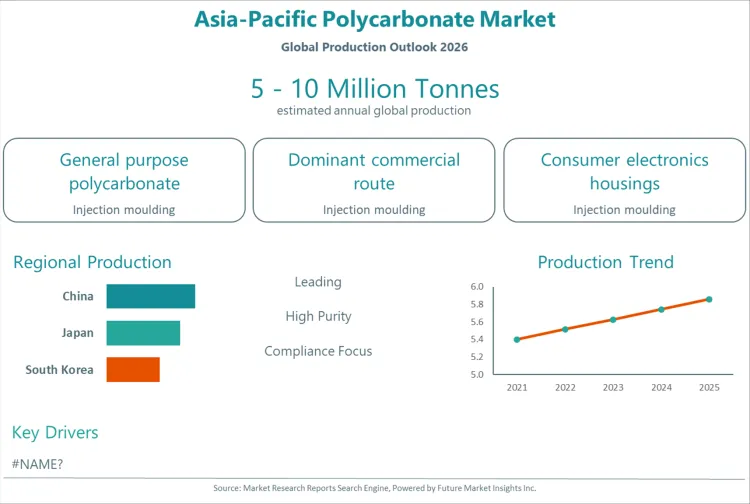
General purpose grades represent the largest volume share due to broad applicability. Optical and flame retardant grades command higher unit value and require tighter quality control. Medical grades remain smaller in volume but demand rigorous certification, traceability, and supply continuity.
Phosgene based processes dominate due to scale and product quality. Non phosgene routes gain traction where safety and regulatory considerations drive technology selection. Buyers value producers with integrated BPA supply and advanced compounding capability.
Electronics remains the primary consumption anchor due to manufacturing concentration in the region. Automotive demand grows steadily with lightweighting and electrification trends. Construction demand varies by country and infrastructure investment cycles, while medical uses prioritise reliability and compliance.
China dominates regional capacity with large integrated complexes and expanding domestic consumption. Export volumes adjust with internal demand cycles.
Japan focuses on high performance and optical grade polycarbonate supported by long standing OEM relationships.
South Korea supplies electronics and automotive chains with advanced materials and strong export orientation.
Taiwan maintains niche capacity aligned with electronics manufacturing.
Southeast Asia relies on imports while showing gradual demand growth in construction and consumer goods.
The polycarbonate supply chain begins with phenol and acetone production followed by bisphenol A synthesis, polymerisation, compounding, and distribution to converters and OEMs. Feedstock integration provides a significant advantage in cost control and operating stability.
Primary cost drivers include bisphenol A pricing, energy consumption, operating rates, and additive costs for modified grades. Trade flows are active within Asia-Pacific, with China acting as both exporter and importer depending on grade requirements and regional balance.
The Asia-Pacific polycarbonate ecosystem includes phenol producers, BPA manufacturers, polymer producers, compounders, OEMs, and converters. Integration across the value chain supports scale efficiency, while specialty producers compete through application development and technical support.
Strategic considerations include managing capacity utilisation, protecting margins through grade differentiation, addressing regulatory scrutiny around BPA, and ensuring resilience across energy and feedstock supply.
Asia-Pacific polycarbonate production capacity in 2026 is estimated at approximately 7.5 to 8.8 million tonnes.
Key influences include bisphenol A availability, energy costs, operating rates, and the share of specialty grades.
China benefits from large scale integration, strong domestic consumption, and coordinated investment across upstream and downstream assets.
Buyers evaluate mechanical and optical performance, regulatory compliance, processing compatibility, and long term supply reliability.
Explore Polymers & Plastics Insights
View Reports
Asia-Pacific Polycarbonate Production Capacity and Growth Outlook

Thank you!
You will receive an email from our Business Development Manager. Please be sure to check your SPAM/JUNK folder too.
