On this page

    Iso-Butanol Price and Production Outlook

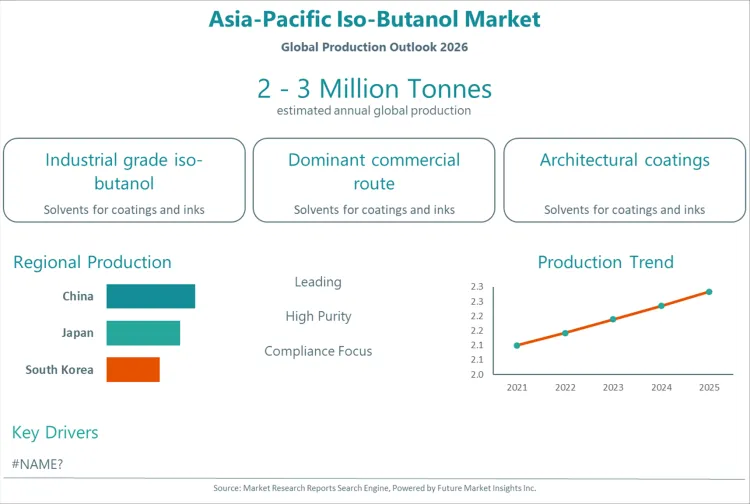
    Asia-Pacific iso-butanol production capacity in 2026 is estimated at approximately 2 to 3 million tonnes, reflecting a mature but structurally shifting market. Demand growth is supported by coatings, solvents, chemical intermediates, and fuel blending applications, while supply dynamics are shaped by refinery integration, oxo-alcohol economics, and feedstock availability.

    Industry conditions show moderate growth with cyclical sensitivity to construction, automotive coatings, and industrial activity. Pricing remains closely linked to propylene availability, syngas economics, and regional operating rates. Producers balance steady downstream demand with exposure to margin compression during periods of oversupply or weak end-use consumption.

    Production leadership is concentrated in China, Japan, South Korea, and Taiwan, supported by integrated petrochemical complexes and strong downstream chemical manufacturing. China anchors regional volume growth driven by domestic coatings, solvents, and fuel blending demand. Japan and South Korea emphasize high-purity and specialty applications. Southeast Asia remains largely import dependent but shows rising consumption linked to industrialisation and infrastructure development.
    Asia Pacific Iso Butanol Market

    Key Questions Answered

    • How sensitive is isobutanol demand to industrial and construction cycles?
    • How do propylene and syngas costs influence production economics?
    • How does integration with oxoalcohol chains affect margins?
    • How do regional trade flows balance supply volatility?

    Iso-Butanol: Product Families That Define How Buyers Actually Use It

    Product Classification

    • Industrial grade isobutanol
    • Solvents for coatings and inks
    • Chemical intermediates
    • Industrial cleaners
    • Chemical synthesis grade isobutanol
      • Isobutyl acetate
      • Plasticisers
      • Specialty esters
    • Fuel and blending grade isobutanol
      • Gasoline blending
      • Biofuel formulations
      • Octane enhancement
    • Specialty and highpurity isobutanol
      • Electronics chemicals
      • Pharmaceutical intermediates
      • Performance coatings

    Industrial and chemical synthesis grades dominate Asia-Pacific demand due to their broad applicability and consistent consumption profiles. Buyers prioritise purity consistency, supply reliability, and predictable pricing mechanisms. Fuel blending applications remain regionally selective, influenced by regulatory frameworks and fuel standards.

    Key Questions Answered

    • How do buyers differentiate industrial and synthesis grades?
    • How do purity specifications affect downstream yields?
    • How does fuel blending regulation shape demand?
    • How do specialty grades justify premium pricing?

    Iso-Butanol: Process Routes That Define Cost, Scale, and Market Positioning

    Process Classification

    • Oxo synthesis (propylenebased)
      • Dominant commercial route
      • Integrated petrochemical complexes
      • High throughput production
    • Fermentationbased isobutanol
      • Biobased feedstocks
      • Smaller scale deployment
      • Higher cost structure
    • Integrated oxoalcohol chains
      • Shared syngas infrastructure
      • Flexible alcohol output
      • Cost optimisation benefits
    • Downstream esterification integration
      • Valueadded derivatives
      • Reduced logistics cost
      • Improved margin stability

    Oxo synthesis remains the primary production route due to scale efficiency and integration advantages. Fermentation-based routes attract interest for sustainability positioning but remain limited by cost and scale constraints. Buyers benefit from integrated producers offering stable quality and flexible contract structures.

    Key Questions Answered

    • How sensitive are costs to propylene pricing?
    • How do oxoalcohol integrations improve economics?
    • How competitive are biobased routes today?
    • How does downstream integration stabilise margins?

    Iso-Butanol: End-Use Spread Across Key Demand Segments

    End-Use Segmentation

    • Coatings and paints
      • Architectural coatings
      • Automotive finishes
      • Industrial coatings
    • Chemical intermediates
      • Esters and solvents
      • Plasticisers
      • Specialty chemicals
    • Fuel and energy applications
      • Gasoline blending
      • Renewable fuel additives
      • Performance fuels
    • Consumer and industrial products
      • Adhesives and sealants
      • Cleaning agents
      • Printing inks

    Coatings and chemical intermediates account for the majority of regional consumption, providing relatively stable baseline demand. Fuel applications offer incremental growth but remain policy-driven and uneven across markets. Buyers focus on consistent supply, regulatory compliance, and cost transparency.

    Key Questions Answered

    • How does construction activity influence demand?
    • How do downstream derivative markets shape volumes?
    • How material is fuel blending to total demand?
    • How do buyers manage substitution risk?

    Iso-Butanol: Asia-Pacific Regional Production Assessment

    China

    China leads regional capacity with integrated oxo-alcohol production and strong domestic demand. Export volumes fluctuate with domestic consumption cycles.

    Japan

    Japan focuses on high-purity and specialty iso-butanol grades serving electronics, coatings, and chemical synthesis markets.

    South Korea

    South Korea supplies both domestic and export markets through integrated petrochemical facilities linked to downstream chemical manufacturing.

    Taiwan

    Taiwan maintains niche production aligned with electronics and specialty chemical demand.

    Southeast Asia

    Consumption grows steadily, but production remains limited, increasing reliance on imports from Northeast Asia.

    Key Questions Answered

    • How do domestic demand patterns shape capacity utilisation?
    • How do export strategies manage cyclical risk?
    • How do logistics costs affect regional competitiveness?
    • How do regulations influence market access?

    Iso-Butanol Supply Chain, Cost Drivers, and Trade Patterns

    Iso-butanol supply chains begin with propylene and syngas production, followed by oxo synthesis, purification, storage, and distribution. Integrated producers benefit from feedstock security and cost optimisation.

    Propylene pricing is the dominant cost driver, while energy, hydrogen, and catalyst costs influence operating margins. Trade flows are active within Asia-Pacific, with China acting as both importer and exporter depending on market conditions. Specialty grades exhibit lower trade elasticity due to qualification requirements.

    Key Questions Answered

    • How does feedstock integration reduce volatility?
    • How do producers manage inventory cycles?
    • How do specialty grades affect trade exposure?
    • How do buyers benchmark delivered cost?

    Iso-Butanol: Ecosystem View and Strategic Themes

    The iso-butanol ecosystem includes petrochemical producers, downstream chemical manufacturers, coatings companies, fuel blenders, and distributors. Integrated value chains support operational efficiency, while specialty producers compete through quality and application support.

    Strategic themes include margin optimisation through integration, selective capacity additions, sustainability positioning, and risk management across cyclical end markets.

    Deeper Questions Decision Makers Should Ask

    • How exposed is demand to construction and automotive cycles?
    • How secure is longterm propylene supply?
    • How differentiated is the product portfolio?
    • How resilient are margins during downturns?
    • How flexible are plants across alcohol outputs?
    • How defensible are customer relationships?
    • How credible are sustainability claims?

    Bibliography

    • Encyclopedia of Polymer Science and Technology. (2024). Alcohol intermediates in coatings, solvents, and fuels. Wiley.
    • Towler, G., & Sinnott, R. (2024). Chemical engineering design: Principles, practice and economics of plant and process design (3rd ed.). Elsevier.
    • Ullmann’s Encyclopedia of Industrial Chemistry. (2024). Oxo alcohols and higher alcohols. Wiley-VCH.

    Frequently Asked Questions

    What is the estimated Asia-Pacific iso-butanol production capacity in 2026?

    Asia-Pacific iso-butanol production capacity in 2026 is estimated at approximately 2-3 million tonnes, led by China, Japan, and South Korea.

    What are the biggest cost drivers shaping iso-butanol pricing?

    Key cost drivers include propylene feedstock pricing, syngas economics, energy costs, and plant utilisation rates.

    How does demand cyclicality affect pricing stability?

    Pricing tends to soften during construction and coatings downturns, while integrated producers are better positioned to manage margin volatility.

    How do buyers choose between commodity and specialty iso-butanol grades?

    Buyers assess purity requirements, downstream yield performance, regulatory compliance, and long-term supply reliability.

    Key Questions Answered in the Report

    Supply chain and operations

    • How stable is propylene sourcing?
    • How flexible is alcohol slate production?
    • How efficient is plant utilisation?
    • How resilient are logistics routes?
    • How quickly can output adjust?
    • How consistent is product quality?
    • How robust are safety systems?
    • How exposed are plants to outages?

    Procurement and raw materials

    • How are propylene contracts structured?
    • How volatile are feedstock prices?
    • How diversified are suppliers?
    • How are catalysts sourced?
    • How do buyers manage price passthrough?
    • How are longterm contracts negotiated?
    • How is compliance verified?
    • How do sourcing strategies vary by country?

    Technology and innovation

    • How efficient are oxo synthesis units?
    • How viable are biobased alternatives?
    • How do producers improve energy efficiency?
    • How is digital optimisation applied?
    • How are emissions reduced?
    • How do new catalysts improve yields?
    • How are plants modernised?
    • How do partnerships accelerate innovation?

    Buyer, channel, and who buys what

    • Which sectors drive baseline demand?
    • How do buyers qualify suppliers?
    • How do customers manage substitution risk?
    • What volumes define key contracts?
    • How do buyers balance price and purity?
    • How do channels differ regionally?
    • How do buyers verify consistency?
    • How do users manage supply disruption?

    Pricing, contract, and commercial model

    • What benchmarks guide isobutanol pricing?
    • How frequent are price adjustments?
    • How are feedstock surcharges handled?
    • How do contracts differ by grade?
    • How long are supply agreements?
    • How are disputes resolved?
    • How is export pricing structured?
    • How do producers protect margins?

    Plant assessment and footprint

    • Which locations offer feedstock security?
    • What defines efficient scale?
    • How do energy costs vary regionally?
    • How do environmental regulations affect operations?
    • How available is skilled labour?
    • How modern are purification assets?
    • How adaptable are plants to demand shifts?
    • How suitable are sites for expansion?

    Explore Hydrocarbons, Petrochemicals, and Organic Chemicals Insights

    View Reports

    Trusted By
    Market Research Reports Search Engine

    Asia-Pacific Iso-Butanol Production Capacity and Growth Outlook