On this page
Asia-Pacific ethanol production capacity in 2026 is estimated at approximately 30 to 40 million tonnes, making the region the largest global source of ethanol output. Production growth is led by China and India through grain based and sugar based fermentation, while Southeast Asia contributes through molasses and cassava feedstocks. Australia and parts of Northeast Asia maintain smaller but stable production bases focused on fuel blending and industrial use.
Pricing conditions are closely tied to feedstock availability, government blending targets, energy input costs, and co product economics. Variability in crop yields and harvest timing introduces cost volatility, while changes in blending mandates directly affect production rates. Producers rely on distillers dried grains, vinasse, and recovered carbon dioxide to support operating economics.
Production concentration remains highest in China and India due to scale, policy support, and domestic fuel demand. Thailand and Indonesia support regional supply through molasses based production. Japan and South Korea depend more heavily on imports due to limited agricultural feedstocks and domestic production capacity.
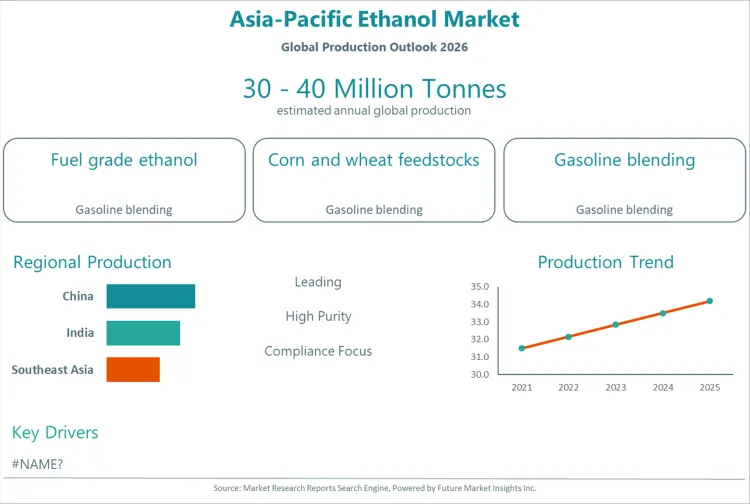
Fuel grade ethanol accounts for the largest share of regional volumes due to transport fuel programs. Industrial and potable grades provide higher unit value and require tighter quality control. Pharmaceutical grades remain smaller in volume but demand strict certification and traceability.
Conventional fermentation routes dominate due to established infrastructure and feedstock access. Advanced routes remain at early stages with limited contribution to regional output. Buyers benefit from producers with diversified feedstock sourcing and operational flexibility.
Transport fuels represent the primary consumption anchor driven by national blending policies. Industrial and beverage uses provide steady non fuel demand. Healthcare related consumption expanded structurally and remains an important specialty segment.
China leads regional ethanol output supported by grain based production and fuel blending programs, while managing feedstock allocation between food and energy use.
India expands capacity rapidly through sugarcane and grain diversion aligned with national blending targets and farmer income support.
Thailand and Indonesia contribute molasses based supply with production tied to sugar output cycles.
Australia maintains stable grain based production focused on domestic fuel blending and industrial consumption.
These countries rely largely on imports due to limited domestic feedstock availability and production capacity.
The ethanol supply chain begins with agricultural feedstock sourcing followed by fermentation, distillation, dehydration, storage, and distribution to fuel blenders, industrial users, and beverage producers. Co products play a critical role in supporting plant economics and waste management.
Primary cost drivers include feedstock prices, energy consumption, labour, and compliance costs. Trade flows within Asia-Pacific are active, with exports from Southeast Asia and Australia supplying Northeast Asian demand. Imports from outside the region supplement supply during feedstock shortages or demand spikes.
The Asia-Pacific ethanol ecosystem includes agricultural producers, bio refineries, fuel blenders, chemical users, beverage producers, regulators, and logistics providers. Alignment across agriculture, energy, and transport policy remains central to long term stability.
Strategic considerations include feedstock diversification, energy efficiency investments, water management, emissions compliance, and resilience against policy shifts affecting blending requirements.
Asia-Pacific ethanol production capacity in 2026 is estimated at approximately 30 to 40 million tonnes.
Key drivers include agricultural feedstock prices, energy costs, operating efficiency, and regulatory compliance requirements.
Co products such as animal feed, vinasse, and recovered carbon dioxide provide essential revenue and cost offsets.
Buyers assess price competitiveness, sustainability certification, supply reliability, and logistics efficiency.
Explore Energy and Environmental Chemicals Insights
View Reports
Asia-Pacific Ethanol Production Capacity and Growth Outlook

Thank you!
You will receive an email from our Business Development Manager. Please be sure to check your SPAM/JUNK folder too.
