On this page
Asia-Pacific butyl acetate production capacity in 2026 is estimated at approximately 3 to 4 million tonnes, supported by extensive oxo alcohol infrastructure and strong downstream solvent consumption. Capacity expansion over the past decade has been led by China through integrated oxo alcohol and esterification investments, while Northeast Asia focuses on quality consistency and supply reliability rather than rapid scale additions.
Pricing conditions are primarily influenced by n-butanol and iso-butanol availability, acetic acid pricing, energy costs, and plant operating rates. Periods of oxo alcohol tightness translate quickly into higher ester costs, while surplus alcohol availability supports margin recovery for ester producers. Logistics costs and storage availability also influence delivered pricing due to flammability handling requirements.
Production concentration is highest in China, followed by South Korea, Japan, and Taiwan. China anchors regional volume output with strong integration and proximity to coatings and inks manufacturing. Japan and South Korea emphasise high purity and specialty solvent grades. Southeast Asia remains partially import dependent despite growing downstream consumption.
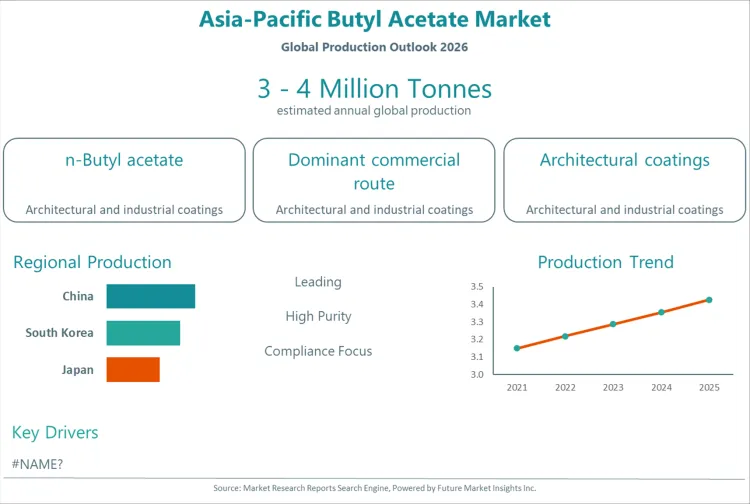
n-Butyl acetate accounts for the majority of regional volumes due to its broad applicability and favourable solvency balance. Iso-butyl acetate and high purity grades represent smaller shares but require tighter specification control and support higher value supply relationships.
Integrated esterification units offer cost and supply advantages through feedstock security. Non integrated producers face greater exposure to alcohol price volatility. Buyers value suppliers with consistent quality, odour control, and reliable delivery schedules.
Coatings remain the primary consumption anchor driven by construction activity and industrial output. Printing inks provide steady demand linked to packaging growth. Adhesives and specialty uses support diversification and higher specification requirements.
China dominates regional capacity through integrated oxo alcohol and esterification complexes serving domestic coatings and inks consumption.
South Korea supplies high quality solvent grades supported by advanced chemical integration and export oriented production.
Japan focuses on specialty and high purity butyl acetate aligned with electronics, automotive, and precision coatings.
Taiwan maintains limited capacity linked to electronics manufacturing demand.
Southeast Asia relies on imports while showing rising consumption in coatings and packaging applications.
The butyl acetate supply chain begins with oxo alcohol and acetic acid sourcing followed by esterification, purification, storage, and distribution to formulators and industrial users. Flammable handling requirements increase the importance of local production and storage availability.
Primary cost drivers include butanol pricing, acetic acid costs, energy consumption, and catalyst efficiency. Trade flows are active within Asia-Pacific, with China acting as a major exporter during periods of high operating rates. Specialty grades tend to remain closer to production sites due to qualification and logistics constraints.
The Asia-Pacific butyl acetate ecosystem includes oxo alcohol producers, esterification operators, coatings and ink manufacturers, adhesive formulators, distributors, and logistics providers. Integration across alcohol and ester production supports cost efficiency and supply resilience.
Strategic considerations include managing oxo alcohol exposure, maintaining operating flexibility across ester grades, ensuring compliance with solvent regulations, and aligning capacity utilisation with downstream demand cycles.
Asia-Pacific butyl acetate production capacity in 2026 is estimated at approximately 3 to 4 million tonnes.
Key influences include n-butanol and iso-butanol availability, acetic acid pricing, energy costs, and plant operating rates.
China benefits from extensive oxo alcohol integration, large scale esterification assets, and proximity to coatings and inks manufacturing.
Buyers evaluate solvency balance, evaporation rate, odour profile, formulation compatibility, and supply reliability.
Explore Hydrocarbons, Petrochemicals, and Organic Chemicals Insights
View Reports
Asia-Pacific Butyl Acetate Production Capacity and Growth Outlook

Thank you!
You will receive an email from our Business Development Manager. Please be sure to check your SPAM/JUNK folder too.
