On this page

    Ammonia Fuel Production and Capacity Outlook

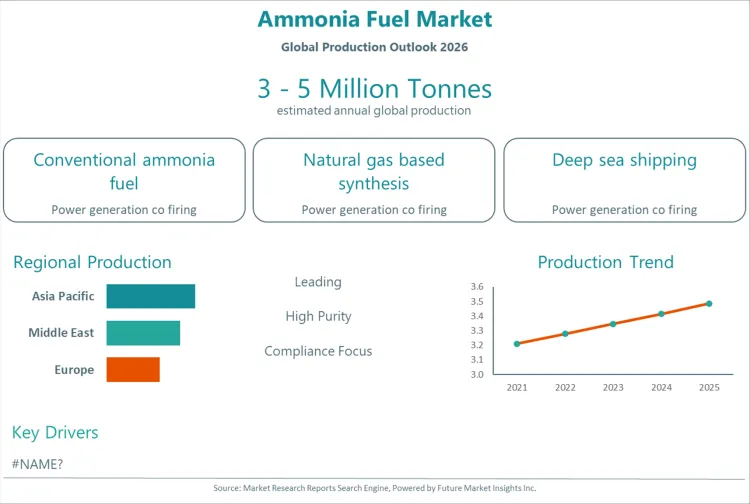
    Global ammonia production capacity suitable for fuel applications in 2026 is estimated at approximately 3 to 5 million tonnes on an ammonia equivalent basis, representing a small but expanding share of total ammonia output. Growth is driven by decarbonisation strategies in shipping, power generation and industrial energy use rather than by traditional fertiliser demand. Capacity expansion focuses on retrofitting existing ammonia plants for fuel grade output and developing new low carbon ammonia projects.

    Production leadership remains linked to regions with established ammonia infrastructure, access to low cost energy inputs and supportive policy frameworks. Asia Pacific leads early fuel trials in shipping and power generation. The Middle East positions itself as a major export hub leveraging large scale ammonia plants and port access. Europe advances ammonia fuel development through pilot projects and regulatory driven decarbonisation mandates. North America supports growth through technology development, power sector trials and industrial energy use. Many regions remain dependent on imports due to limited ammonia production capacity or lack of upgrading infrastructure.

    Early demand remains project driven and policy supported. Buyers prioritise supply reliability, fuel specification consistency and long term regulatory clarity.
    Ammonia Fuel Market

    Key Questions Answered

    • How much existing ammonia capacity can be converted for fuel use?
    • How quickly can low carbon ammonia supply scale?
    • How do energy input costs affect ammonia fuel economics?
    • How does regulation influence investment timelines?

    Ammonia Fuel Product Families That Define How Buyers Actually Use It

    Product Classification

    • Conventional ammonia fuel
      • Power generation co firing
      • Marine engine trials
      • Industrial fuel switching
    • Blue ammonia fuel
      • Carbon capture integrated production
      • Transitional fuel applications
      • Export oriented supply
    • Green ammonia fuel
      • Renewable powered electrolysis
      • Zero carbon fuel pathways
      • Long term decarbonisation use
    • Fuel grade ammonia derivatives
      • Cracked ammonia for hydrogen use
      • Ammonia based energy carriers
      • Hybrid fuel systems

    Green and blue ammonia dominate strategic planning despite limited near term volumes. Buyers distinguish fuel grades based on carbon intensity, impurity limits and compatibility with combustion or fuel cell systems.

    Key Questions Answered

    • How do buyers differentiate fuel grade and fertiliser grade ammonia?
    • How does carbon intensity influence procurement decisions?
    • How do impurity limits affect engine and turbine performance?
    • How do derivative fuels expand usability?

    Ammonia Fuel Process Routes That Define Cost, Carbon Intensity and Scale

    Process Classification

    • Conventional ammonia production with retrofit
      • Natural gas based synthesis
      • Fuel grade upgrading
      • Transitional deployment
    • Blue ammonia production
      • Integrated carbon capture systems
      • Lower emissions profile
      • Infrastructure dependent scaling
    • Green ammonia production
      • Electrolysis based hydrogen
      • Renewable power integration
      • High capital intensity
    • Ammonia cracking and conversion systems
      • Hydrogen release for end use
      • Efficiency trade offs
      • Infrastructure complexity

    Process selection directly affects cost, emissions intensity and scalability. Near term deployment favours retrofitted conventional and blue ammonia, while green ammonia defines long term fuel strategies.

    Key Questions Answered

    • How sensitive ammonia fuel cost is to energy pricing?
    • How do carbon capture rates influence competitiveness?
    • How does renewable intermittency affect output stability?
    • How do conversion losses affect delivered energy value?

    Ammonia Fuel End Use Spread Across Key Sectors

    End Use Segmentation

    • Maritime transport
      • Deep sea shipping
      • Port and auxiliary power
      • Dual fuel engine systems
    • Power generation
      • Coal and gas co firing
      • Dedicated ammonia turbines
      • Grid balancing applications
    • Industrial energy
      • High temperature process heat
      • Cement and steel pilots
      • Distributed energy systems
    • Hydrogen carrier applications
      • Cracked ammonia hydrogen supply
      • Fuel cell integration
      • Industrial hydrogen replacement

    Shipping and power generation dominate early adoption due to scale and decarbonisation pressure. Industrial use develops more gradually due to retrofit complexity and safety considerations.

    Key Questions Answered

    • How do ship operators evaluate ammonia fuel readiness?
    • How do utilities assess combustion performance and safety?
    • How do industrial users manage retrofit costs?
    • How does ammonia compare with alternative low carbon fuels?

    Ammonia Fuel Regional Production and Adoption Potential

    Asia Pacific

    Asia Pacific leads pilot adoption in shipping and power supported by policy initiatives and large ammonia import infrastructure.

    Middle East

    The Middle East positions itself as a major export supplier through blue and green ammonia projects tied to energy advantage and port access.

    Europe

    Europe advances ammonia fuel through regulatory mandates, demonstration projects and emissions reduction targets.

    North America

    North America supports development through technology pilots, power sector trials and hydrogen carrier strategies.

    Latin America and Africa

    These regions show emerging potential linked to renewable resources but remain at early development stages.

    Key Questions Answered

    • How do regional policies accelerate adoption?
    • How do export focused regions manage logistics and safety?
    • How do importing regions secure long term supply?
    • How does infrastructure readiness shape competitiveness?

    Ammonia Fuel Supply Chain, Cost Drivers and Trade Patterns

    The ammonia fuel supply chain spans ammonia synthesis, purification, storage, transport and end use conversion. Existing fertiliser infrastructure provides a foundation, but fuel use introduces additional safety, handling and specification requirements.

    Energy input costs, carbon capture investment and renewable power availability dominate production economics. Transport relies on established ammonia shipping routes, though port modifications and safety upgrades are required. Early trade patterns focus on long distance exports from energy advantaged regions to demand centres.

    Contracts increasingly link price to energy input indices, carbon intensity metrics and long term offtake commitments.

    Key Questions Answered

    • How do energy prices influence ammonia fuel competitiveness?
    • How do transport and storage requirements affect delivered cost?
    • How do buyers benchmark blue versus green ammonia supply?
    • How do safety standards shape supply chain design?

    Ammonia Fuel Ecosystem View and Strategic Themes

    The ammonia fuel ecosystem includes ammonia producers, energy companies, engine manufacturers, shipowners, utilities, port authorities and regulators. Early deployment depends on cross sector coordination rather than isolated investment.

    Strategic themes include fuel standardisation, safety regulation alignment, infrastructure retrofitting and long term carbon policy visibility.

    Deeper Questions Decision Makers Should Ask

    • How secure is long term ammonia fuel supply?
    • How diversified are production pathways?
    • How resilient are projects to policy shifts?
    • How scalable is port and bunkering infrastructure?
    • How mature are engine and turbine technologies?
    • How transparent are carbon accounting frameworks?
    • How aligned are stakeholders across the value chain?
    • How quickly can costs decline with scale?

    Bibliography

    • International Energy Agency. (2024). Ammonia technology roadmap: Tracking clean ammonia deployment and fuel applications. IEA Publications.
    • International Energy Agency. (2023). World energy outlook 2023: Hydrogen, ammonia, and alternative fuels. IEA Publications.
    • USA Department of Energy. (2024). Ammonia as a hydrogen carrier and carbon-free fuel: Technical and economic assessment. Office of Energy Efficiency and Renewable Energy.

    Frequently Asked Questions

    What is the estimated global ammonia fuel volume in 2025?

    Global ammonia fuel use in 2025 is estimated at approx. 3 to 5 million tonnes, primarily in pilot shipping and power generation projects.

    What are the biggest cost drivers shaping ammonia fuel economics?

    Key drivers include energy input costs, carbon capture investment, renewable power availability and infrastructure modification expenses.

    How does ammonia fuel compare with hydrogen as an energy carrier?

    Ammonia offers easier storage and transport than hydrogen but requires cracking or specialised combustion systems, introducing efficiency trade offs.

    How do safety concerns affect ammonia fuel adoption?

    Toxicity and handling risks require enhanced safety systems, regulatory oversight and operator training, influencing deployment speed.

    Which sectors are most likely to adopt ammonia fuel first?

    Maritime shipping and power generation are expected to lead early adoption due to scale, emissions pressure and fewer alternatives.

    Key Questions Answered in the Report

    Supply chain and operations

    • How predictable is ammonia fuel output?
    • How stable are storage and handling systems?
    • How effective are safety and monitoring controls?
    • How resilient are logistics and port operations?
    • How quickly can capacity be expanded?
    • How are emergency scenarios managed?
    • How robust are training and certification systems?
    • How are operational disruptions handled?

    Procurement and raw material

    • How is ammonia fuel priced in contracts?
    • How do suppliers certify carbon intensity?
    • How is price volatility managed?
    • What contract duration supports investment?
    • How are alternative suppliers qualified?
    • How do buyers manage supply risk?
    • How are audits conducted?
    • How do onboarding requirements differ by region?

    Technology and innovation

    • How do engine technologies improve efficiency?
    • How does cracking technology evolve?
    • How are emissions monitored and reduced?
    • How do safety systems advance?
    • How does digital monitoring support operations?
    • How do pilots transition to scale?
    • How do partnerships accelerate deployment?
    • How does innovation reduce cost barriers?

    Buyer, channel and who buys what

    • Which sectors adopt ammonia fuel first?
    • How do shipowners evaluate fuel trade offs?
    • What volumes define standard offtake agreements?
    • How do buyers compare ammonia with alternatives?
    • How do channels influence delivered cost?
    • How do buyers verify sustainability claims?
    • How do users manage operational risk?
    • How do specifications vary by application?

    Pricing, contract and commercial model

    • What benchmarks guide ammonia fuel pricing?
    • How often are pricing reviews conducted?
    • How do contracts balance risk and flexibility?
    • How do buyers compare blue and green supply?
    • What duration supports project viability?
    • How are disputes resolved?
    • How do incentives support early adoption?
    • How do terms vary by end use?

    Plant assessment and footprint

    • Which regions offer reliable energy access?
    • What investment defines competitive scale?
    • How do permitting timelines affect deployment?
    • How suitable are ports and storage sites?
    • How consistent are regulatory conditions?
    • How are safety audits managed?
    • How does workforce readiness affect operations?
    • How do transport links support trade?

    Explore Fuel Insights

    View Reports
    Market Research Reports Search Engine

    Ammonia Fuel Global Production Capacity and Growth Outlook