Alkoxylates Production and Capacity Outlook
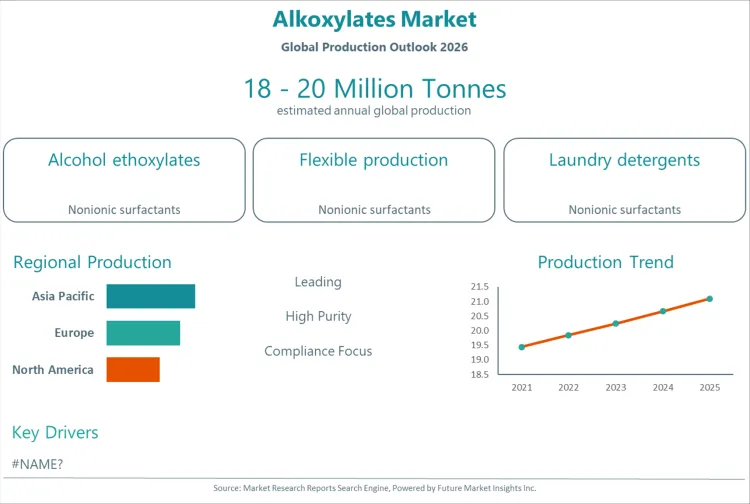
Global alkoxylates production capacity in 2026 is estimated at approximately 18 to 20 million tonnes, reflecting steady expansion supported by home care, personal care, industrial cleaning and agricultural formulation demand. Capacity growth is primarily incremental and integrated, with additions linked to ethylene oxide and propylene oxide availability rather than standalone merchant expansion. Industry conditions balance consistent downstream pull with feedstock volatility, energy sensitivity and tightening environmental oversight.
Production leadership remains concentrated in regions with secure oxide supply, access to fatty alcohols and strong formulation ecosystems. Asia Pacific leads capacity growth driven by scale advantages and expanding consumer and industrial applications. Europe maintains a strong position in specialty and regulated alkoxylates aligned with sustainability and safety requirements. North America supports stable output tied to household, institutional and industrial cleaning demand. Several regions remain import dependent due to limited oxide integration.
Demand stability is reinforced by recurring consumption in cleaning and formulation intensive uses. Buyers prioritise performance consistency, formulation compatibility and regulatory compliance.
Key Questions Answered
- How closely is alkoxylate capacity linked to ethylene oxide and propylene oxide supply?
- How do formulation trends influence capacity utilisation?
- How do energy and feedstock costs affect operating economics?
- How do environmental regulations influence product portfolios?
Alkoxylates Product Families That Define How Buyers Actually Use Them
Product Classification
- Alcohol ethoxylates
- Nonionic surfactants
- Detergents and cleaners
- Industrial formulations
- Alcohol propoxylates
- Low foam applications
- Industrial cleaning
- Process aids
- Mixed ethoxylated propoxylated products
- Performance tuned surfactants
- Emulsifiers and dispersants
- Specialty formulations
- Specialty and bio based alkoxylates
- Low toxicity products
- Renewable feedstock based surfactants
- Regulatory compliant alternatives
Alcohol ethoxylates dominate global consumption due to versatility and cost effectiveness. Specialty grades gain share where performance differentiation and regulatory compliance are critical.
Key Questions Answered
- How do buyers select ethoxylated versus propoxylated products?
- How does degree of alkoxylation affect performance?
- How do low foam requirements influence grade choice?
- How does sustainability influence procurement decisions?
Alkoxylates Process Routes That Define Cost, Control and Scale
Process Classification
- Batch alkoxylation
- Flexible production
- Broad product slate
- Specialty grade focus
- Continuous alkoxylation
- High volume output
- Consistent quality
- Lower unit cost
- Integrated oxide based production
- Feedstock security
- Reduced logistics exposure
- Improved cost predictability
- Finishing and neutralisation
- Catalyst removal
- Colour and odour control
- Specification tightening
Process selection reflects trade offs between flexibility, scale and quality control. Integration with oxide production improves supply reliability and margin stability.
Key Questions Answered
- How sensitive alkoxylate cost is to oxide pricing?
- How does process choice affect product consistency?
- How do safety requirements influence plant design?
- How does integration reduce operational risk?
Alkoxylates End Use Spread Across Key Sectors
End Use Segmentation
- Home and personal care
- Laundry detergents
- Dishwashing liquids
- Shampoos and body wash
- Industrial and institutional cleaning
- Surface cleaners
- Degreasers
- Food processing sanitation
- Agriculture
- Crop protection adjuvants
- Wetting and spreading agents
- Emulsifier systems
- Industrial applications
- Textile processing
- Metalworking fluids
- Oilfield chemicals
Home and industrial cleaning account for the largest share of consumption. Agricultural and industrial uses introduce seasonality and formulation specificity.
Key Questions Answered
- How do formulators balance cleaning performance and mildness?
- How does agricultural seasonality affect demand patterns?
- How do industrial users manage foam control requirements?
- How do end users evaluate substitution options?
Alkoxylates Regional Production Potential Assessment
Asia Pacific
Asia Pacific leads global production supported by oxide integration, fatty alcohol availability and strong downstream formulation demand.
Europe
Europe focuses on specialty, low toxicity and regulated alkoxylates aligned with sustainability frameworks.
North America
North America maintains stable production serving household, institutional and industrial cleaning sectors.
Middle East
The Middle East shows emerging potential through petrochemical integration but remains limited in specialty grades.
Latin America and Africa
These regions remain largely import dependent, with consumption tied to detergents and agricultural formulations.
Key Questions Answered
- How do regional regulations affect product mix?
- How do import dependent regions manage supply risk?
- How does proximity to formulators affect competitiveness?
- How do logistics costs affect delivered pricing?
Alkoxylates Supply Chain, Cost Drivers and Trade Patterns
The alkoxylates supply chain begins with fatty alcohols or synthetic alcohols and oxide feedstocks, followed by alkoxylation, finishing and delivery to formulators. Safety and handling considerations for oxides shape plant location and logistics.
Key cost drivers include oxide pricing, alcohol feedstock costs, energy use and compliance requirements. Trade flows connect integrated chemical hubs with detergent and formulation centres.
Contracts emphasise specification stability, formulation support and long term availability.
Key Questions Answered
- How do feedstock prices translate into alkoxylate economics?
- How do safety requirements shape supply chain design?
- How do buyers benchmark alternative surfactant chemistries?
- How do logistics affect supply reliability?
Alkoxylates Ecosystem View and Strategic Themes
The ecosystem includes oxide producers, fatty alcohol suppliers, alkoxylate manufacturers, formulators and regulators. Asia Pacific anchors volume growth, while Europe drives regulatory and sustainability standards.
Strategic themes include low toxicity development, bio based feedstock adoption, formulation performance optimisation and supply chain resilience.
Deeper Questions Decision Makers Should Ask
- How secure is long term oxide and alcohol sourcing?
- How exposed are portfolios to regulatory change?
- How scalable are bio based alkoxylate alternatives?
- How resilient are operations to energy price volatility?
- How robust are safety and compliance systems?
- How aligned are suppliers and formulators on performance goals?
- How transparent are environmental disclosures?
- How quickly can product slates adapt to new rules?
Bibliography
- European Commission Joint Research Centre. (2023). Best available techniques (BAT) for large-volume organic chemicals and surfactant manufacturing. Publications Office of the European Union.
- United Nations Environment Programme. (2023). Chemicals in consumer and industrial products: Environmental performance and risk management. UNEP.
- International Organization for Standardization. (2023). Quality, safety, and environmental management systems for surfactant and specialty chemical production. ISO Standards Publications.
Frequently Asked Questions
What is the estimated global alkoxylates production volume in 2025?
Global alkoxylates production in 2025 is estimated at approximately 18 to 20 million tonnes, supported by cleaning, personal care and industrial demand.
What are the biggest cost drivers shaping alkoxylates pricing?
Pricing is driven by ethylene oxide and propylene oxide costs, alcohol feedstock pricing, energy inputs and regulatory compliance.
How do regulations affect alkoxylate availability?
Regulations targeting toxicity and environmental impact influence product selection and favour compliant and specialty grades.
Why are alkoxylates widely used in surfactant formulations?
Alkoxylates offer tunable performance, strong cleaning efficiency and broad formulation flexibility.
Which sectors drive future alkoxylate demand growth?
Home care, industrial cleaning and agricultural adjuvants are expected to remain the primary growth drivers.