Agrochemical Intermediates Production and Capacity Outlook
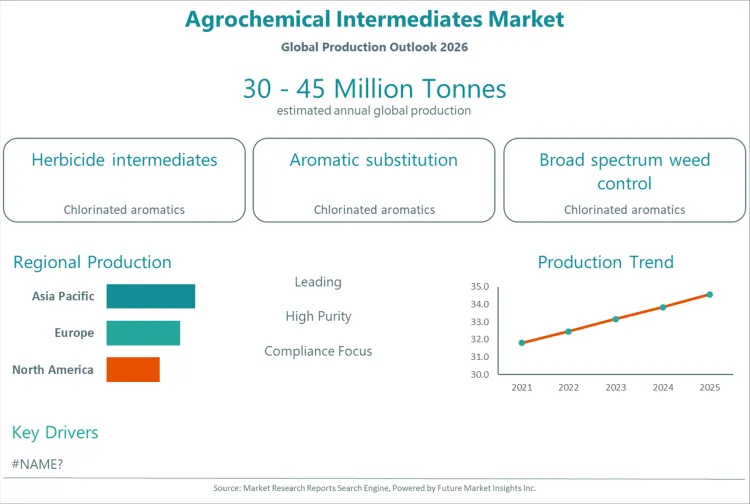
Global agrochemical intermediates production capacity in 2026 is estimated at approximately 30 to 45 million tonnes, reflecting steady growth linked to crop protection demand, formulation upgrades and active ingredient innovation rather than broad volume expansion. Capacity additions are selective and increasingly focused on high value intermediates that support patented and differentiated active ingredients.
Production remains concentrated in regions with established fine chemicals infrastructure, skilled labour availability and proximity to formulation and export hubs. Asia Pacific leads global capacity due to integrated chemical clusters, cost efficiency and scale advantages. Europe maintains a strong position in high complexity and regulated intermediates supported by innovation driven demand. North America focuses on specialty and captive production linked to proprietary molecules. Several regions remain structurally import dependent due to regulatory barriers and limited synthesis capability.
Demand growth is driven by pest resistance management, climate variability and increasing intensity of crop protection programs. Buyers prioritise consistency, regulatory traceability and long term supply security.
Key Questions Answered
- How closely is agrochemical intermediate demand tied to active ingredient innovation?
- How do regulatory approval timelines affect capacity planning?
- How does synthesis complexity limit new supplier entry?
- How resilient is demand across agricultural cycles?
Agrochemical Intermediate Product Families That Define How Buyers Actually Use Them
Product Classification
- Herbicide intermediates
- Chlorinated aromatics
- Triazines and ureas
- Phosphonate derivatives
- Insecticide intermediates
- Pyrethroid building blocks
- Organophosphate intermediates
- Heterocyclic compounds
- Fungicide intermediates
- Azole derivatives
- Sulfur containing intermediates
- Nitrogen heterocycles
- Specialty and patented intermediates
- Chiral intermediates
- High purity synthesis steps
- Custom molecule precursors
Herbicide intermediates account for the largest share of volume, while fungicide and insecticide intermediates drive higher value due to synthesis complexity and regulatory requirements.
Key Questions Answered
- How do buyers qualify intermediates for specific active ingredients?
- How do purity and impurity profiles affect formulation performance?
- How does patent protection influence sourcing strategies?
- How do buyers manage substitution risk?
Agrochemical Intermediates Process Routes That Define Cost, Yield and Compliance
Process Classification
- Chlorination and nitration reactions
- Aromatic substitution
- Hazardous reaction control
- Waste management intensity
- Heterocyclic synthesis
- Multi step reaction sequences
- Catalyst driven selectivity
- High technical complexity
- Phosphorus and sulfur chemistry
- Controlled reagent handling
- Emissions and effluent management
- Regulatory oversight
- Custom synthesis and toll manufacturing
- Client specific process design
- Confidentiality requirements
- Limited scalability
Process routes are characterised by high regulatory scrutiny, waste treatment intensity and strong dependence on skilled process control.
Key Questions Answered
- How sensitive are intermediate costs to energy and reagent pricing?
- How do waste treatment requirements affect economics?
- How does process yield influence supplier competitiveness?
- How do compliance systems shape plant design?
Agrochemical Intermediates End Use Spread Across Crop Protection Segments
End Use Segmentation
- Herbicides
- Broad spectrum weed control
- Selective crop protection
- Resistance management programs
- Insecticides
- Crop and stored grain protection
- Vector control
- Specialty formulations
- Fungicides
- Cereal and fruit protection
- High value crop applications
- Seed treatment products
- Seed treatment and biological hybrids
- Formulation enhancers
- Combination products
- Performance stabilisers
Herbicides dominate volume demand, while fungicides and insecticides exhibit higher formulation diversity and value density.
Key Questions Answered
- How do crop patterns influence intermediate demand?
- How does resistance pressure drive formulation change?
- How do seasonal cycles affect procurement timing?
- How do regulatory bans alter product portfolios?
Agrochemical Intermediates Regional Production Potential Assessment
Asia Pacific
Asia Pacific leads production supported by scale, integrated chemical clusters and export focused manufacturing.
Europe
Europe specialises in high complexity and regulated intermediates aligned with innovation driven agrochemical portfolios.
North America
North America focuses on captive and proprietary intermediates tied to patented active ingredients.
Latin America
Latin America is a major consumption region with limited production, relying heavily on imports.
Africa
Africa shows growing demand but minimal domestic intermediate production capability.
Key Questions Answered
- How do regional regulations affect sourcing strategies?
- How do import dependent regions manage supply risk?
- How does proximity to formulation plants affect competitiveness?
- How do trade restrictions influence availability?
Agrochemical Intermediates Supply Chain, Cost Drivers and Trade Patterns
The agrochemical intermediate supply chain spans basic chemical feedstocks, multi step synthesis, purification and transport to formulation facilities. Regulatory documentation and traceability are critical across all stages.
Key cost drivers include raw material pricing, energy intensity, waste treatment and regulatory compliance. Trade flows connect Asian production hubs with formulation centres in Europe, North America and Latin America.
Contracts prioritise long term supply commitments, quality consistency and regulatory support.
Key Questions Answered
- How do feedstock prices translate into intermediate cost?
- How do logistics and storage affect delivery reliability?
- How do buyers benchmark qualified suppliers?
- How do regulatory audits affect trade flows?
Agrochemical Intermediates Ecosystem View and Strategic Themes
The ecosystem includes basic chemical suppliers, fine chemical manufacturers, agrochemical companies, formulation plants and regulators. Supply concentration reflects the technical and regulatory barriers to entry.
Strategic themes include supply chain resilience, diversification away from single sourcing, investment in compliant capacity and alignment with next generation crop protection chemistry.
Deeper Questions Decision Makers Should Ask
- How secure is long term access to key intermediates?
- How diversified are sourcing options across regions?
- How exposed are portfolios to regulatory bans?
- How scalable are high complexity intermediates?
- How robust are compliance and documentation systems?
- How aligned are suppliers with innovation pipelines?
- How quickly can supply adapt to formulation change?
- How transparent are environmental and safety practices?
Bibliography
- Food and Agriculture Organization of the United Nations. (2024). Crop protection products: Demand trends, resistance management, and agricultural input use. FAO.
- European Chemicals Agency. (2024). Agrochemical substances and intermediates: REACH registration, hazard classification, and compliance requirements. ECHA.
- European Commission Joint Research Centre. (2023). Best available techniques (BAT) for fine chemicals and active substance manufacturing. Publications Office of the European Union.
Frequently Asked Questions
What is the estimated global agrochemical intermediates production volume in 2025?
Global agrochemical intermediates production in 2025 is estimated at approximately 30 to 45 million tonnes, driven by crop protection demand and formulation upgrades.
What are the biggest cost drivers shaping agrochemical intermediate pricing?
Pricing is driven by raw material costs, energy use, waste treatment, regulatory compliance and synthesis complexity.
How do regulations affect agrochemical intermediate availability?
Strict environmental and safety regulations limit new capacity development and favour compliant, established producers.
Why is supply concentrated in specific regions?
High technical complexity, regulatory burden and capital requirements create strong barriers to entry.
Which crop protection segments drive future intermediate demand?
Herbicides and fungicides linked to resistance management and high value crops are expected to drive growth.