On this page
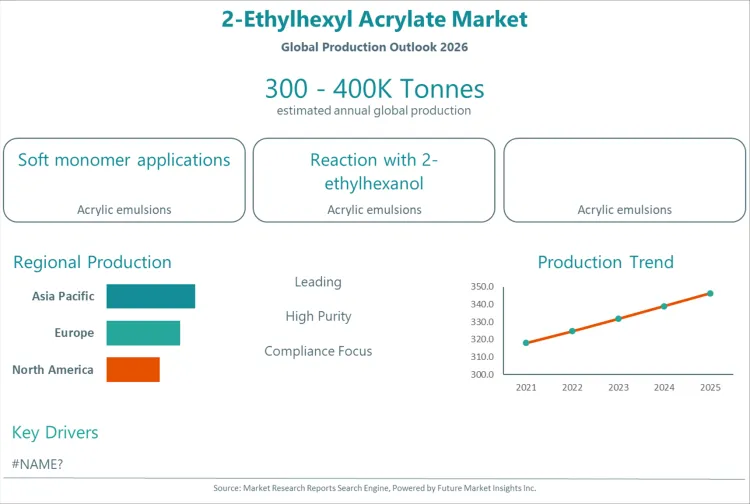
Global 2-ethylhexyl acrylate production in 2026 is estimated at approximately 300 to 400 thousand tonnes, reflecting its role as a high volume soft monomer used to impart flexibility, tack and low temperature performance in polymer systems. Output trends follow demand in water based coatings, pressure sensitive adhesives, construction sealants and elastomers.
Production economics are driven by acrylic acid availability, 2-ethylhexanol sourcing, esterification efficiency, inhibitor usage and energy intensity. Cost behaviour is strongly influenced by upstream propylene dynamics and oxo alcohol capacity utilisation. Producers prioritise high on stream reliability and consistent ester quality due to tight downstream formulation tolerances.
The global supply environment shows steady capacity optimisation rather than aggressive expansion. Incremental debottlenecking and process efficiency improvements dominate investment activity, while large scale greenfield projects remain limited due to capital intensity and feedstock integration requirements.
Production capacity is concentrated among integrated acrylic producers with access to acrylic acid and oxo alcohols. Asia Pacific represents the largest production base supported by scale, downstream coatings demand and integrated feedstock availability. Europe maintains technically advanced capacity focused on specialty and regulated applications. North America supports significant production aligned with architectural coatings, adhesives and elastomers. Several regions rely on imports due to limited esterification infrastructure.
Coatings, adhesives, sealants and elastomers continue to anchor baseline demand due to 2-ethylhexyl acrylate’s ability to lower glass transition temperature and improve durability. Buyers value molecular consistency, inhibitor control and uninterrupted supply.
2-ethylhexyl acrylate is primarily used as a comonomer rather than a standalone resin component. Its inclusion level strongly affects flexibility, adhesion and low temperature performance. Buyers differentiate supply based on purity, inhibitor package performance and batch consistency.
Esterification of acrylic acid with 2-ethylhexanol remains the dominant route. Process control is critical due to polymerisation risk and heat sensitivity. Integrated production provides advantages in cost control and supply reliability.
Coatings and adhesives dominate volume consumption due to continuous demand from construction and manufacturing. Elastomer and specialty polymer uses provide lower volume but higher formulation sensitivity. Buyers focus on supply continuity, consistency and long term formulation stability.
Asia Pacific leads global production supported by integrated acrylic complexes and strong downstream consumption.
Europe maintains regulated capacity focused on specialty, low VOC and compliance driven applications.
North America supports significant production aligned with coatings, adhesives and elastomer manufacturing.
Other regions rely on imports due to limited acrylic acid integration and esterification scale.
The supply chain begins with propylene conversion to acrylic acid, oxo synthesis of 2-ethylhexanol, esterification, purification and distribution. Downstream users include polymer producers, coatings formulators, adhesive manufacturers and elastomer processors.
Key cost drivers include acrylic acid pricing, oxo alcohol availability, energy use, inhibitor systems and logistics. Storage and transport require careful temperature and polymerisation control. Trade flows reflect concentration of production in integrated hubs supplying global downstream users.
Pricing formation reflects feedstock economics, quality specifications and contract duration rather than spot driven volatility.
The ecosystem includes acrylic acid producers, oxo alcohol manufacturers, esterification operators, polymer producers, coatings and adhesive formulators and regulators. Production is concentrated among integrated chemical groups with strong process safety capability.
Equipment suppliers support reactors, distillation columns, inhibitor dosing systems and storage infrastructure. Producers coordinate feedstock sourcing, process safety, compliance and long term customer supply agreements.
Global production in 2026 is estimated at approximately 300 to 400 thousand tonnes, supported by coatings, adhesives and elastomer demand.
Costs are driven by acrylic acid and 2-ethylhexanol availability, energy use, inhibitor systems and purification intensity.
It lowers glass transition temperature and improves flexibility, adhesion and low temperature performance.
Buyers rely on qualified suppliers, inventory buffers and longer term agreements aligned with formulation needs.
Explore Hydrocarbons, Petrochemicals, and Organic Chemicals Insights
View Reports
2-Ethylhexyl Acrylate Global Production Capacity and Growth Outlook

Thank you!
You will receive an email from our Business Development Manager. Please be sure to check your SPAM/JUNK folder too.
