On this page
Global sodium nitrate production in 2025 is estimated at approximately 440 to 450 thousand tonnes, reflecting a mature but strategically relevant inorganic chemicals market. Supply growth remains modest and closely aligned with fertiliser blending demand, industrial explosives consumption and niche food and pharmaceutical applications. Market conditions balance natural resource based production, synthetic routes and regulatory oversight related to environmental and safety standards. The global picture shows stable year on year output with limited capacity additions, shaped more by operational optimisation than greenfield expansion.
Production leadership remains concentrated in regions with access to natural nitrate deposits and established chemical processing infrastructure. Latin America, led by Chile, dominates natural sodium nitrate production due to caliche ore resources. Asia Pacific maintains synthetic production capacity to support fertilisers, chemicals and explosives. Europe and North America operate smaller but consistent capacity focused on industrial and specialty grade supply. Many regions remain import dependent due to limited domestic mineral resources.
Agricultural and industrial applications continue to support baseline demand as buyers value chemical stability, predictable nitrogen content and consistent supply.
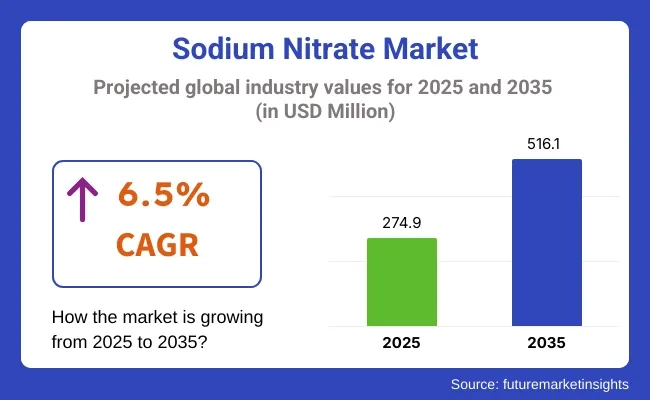
Fertiliser and industrial grades account for the majority of global volumes. Buyers prioritise purity, solubility, moisture control and regulatory compliance depending on end use.
Natural extraction routes benefit from low variable costs but are geographically limited. Synthetic routes provide flexibility and proximity to end markets but carry higher energy and input costs.
Agricultural and explosives applications dominate consumption due to volume requirements and consistent usage patterns. Buyers focus on supply reliability, safety handling and regulatory alignment.
Latin America leads global supply through natural nitrate deposits and export oriented production, particularly supporting agricultural and industrial markets worldwide.
Asia Pacific supports steady synthetic production to meet fertiliser, mining and industrial demand, with limited reliance on imports in some economies.
North America maintains stable but smaller scale capacity focused on industrial, explosives and specialty applications.
Europe relies largely on imports and regional synthetic production, shaped by environmental and safety regulations.
These regions show limited production and depend on imports, with demand linked to mining and infrastructure development.
Sodium nitrate supply chains begin with mining or chemical synthesis followed by purification, storage and distribution to fertiliser blenders, explosives manufacturers and industrial users. Raw material availability, energy costs, labour and logistics dominate the cost structure.
Trade patterns are characterised by bulk exports from natural resource rich regions to import dependent markets. Pricing is typically contract based, influenced by grade, volume, freight and regulatory compliance rather than short term spot volatility.
The sodium nitrate ecosystem includes mining operators, chemical producers, fertiliser blenders, explosives manufacturers, distributors and regulators. Strategic themes focus on resource security, regulatory compliance, logistics efficiency and demand stability.
Producers prioritise operational reliability, environmental management and cost control. Buyers value dependable supply, consistent specifications and transparent sourcing.
Explore Inorganic Chemicals Insights
View Reports
Sodium Nitrate Global Production Capacity and Growth Outlook

Thank you!
You will receive an email from our Business Development Manager. Please be sure to check your SPAM/JUNK folder too.
